07 February 2010

Rah Rah


All the talk about alternate universes in my recent posts on Lost and Fringe brings to mind a little something I wrote, yikes, almost 20 years ago.

I took an intensive Japanese course in the summer of 1991. While about a dozen of us, from high-school students to established professionals, learned the language in an immersion course led by the venerable Eleanor Harz Jorden, about five times as many Japanese graduate students were learning how to teach the same course. They served as aides to our main instructors and were assigned in rotating pairs to each one of us Americans as private tutors. Despite the fact that we were supposed to speak only Japanese with them, even when socializing, our Japanese being so fundamental and their English generally being so good made that difficult.

One of my tutors, Ohmaki-san, asked me for help with the old r and l problem that's known to plague Asians speaking English. He was having particular trouble pronouncing "rarely" as distinct from "really"; it wasn't just the consonants, but something in the diphthong. So he asked me to write a dialogue like the Core Conversations in Dr. Jorden's books for him to practice. For the first time anywhere outside of a small group of young folk in Southeastern Pennsylvania, I proudly share the result:

Brian: Have you ever seen a parallel reality where squirrels quarrel?

Makoto: I have seen squirrels quarrel, but rarely in a parallel reality.

Brian: Really?

Makoto: Really. Rarely.

Brian: Ah soh desu ka.

The next time you might get the urge to make fun of an Asian native who hasn't quite perfected the difference between articulating r and l, keep in mind that Ohmaki-san didn't need me to explain any of the words I used in the dialogue — and then, of course, consider how much Japanese, Korean, or Chinese you speak.

06 February 2010

Women on the Verge, Part I


Logos © 2009 Fox, © 2008 Warner Bros.

To the great anticipation of "genre" buffs and admirers of quality television in general, J.J. Abrams and Joss Whedon both premiered new series on Fox last season. Fringe, created by Abrams with his Star Trek screenwriting team of Alex Kurtzman & Roberto Orci, has just gone on midwinter hiatus. Whedon's Dollhouse ended its erratic run of just over two dozen episodes last week.

I began what became this post, believe it or not, last February — yep, one year ago, the same month this
blog began. As I jotted down notes on the still-new Fringe, which had refocused itself a bit after more than a month off the air, I thought it might be interesting to play compare-and-contrast with the Abrams and Whedon oeuvres come Dollhouse's imminent debut. Both men were known for writing strong women within strong ensembles, and both new shows featured female leads in sci-fi settings.

A few weeks after the long-in-coming
Dollhouse premiere, still wrestling with my feelings for that show, I had to admit that the most relevant difference between the series from a review standpoint was this: Fringe was good.

"While it's painful to say," I wrote, "after three episodes I don't know if
Dollhouse is even promising. Having seen what Whedon is capable of in Buffy [the Vampire Slayer], I'll keep watching; based on his track record, and not just out of wishful thinking, I believe that things could turn around. But if I were coming to the series cold I'd probably already be gone."

The fact that I kept falling behind on
Dollhouse delayed this post repeatedly. Given that my enjoyment of Fringe only grew, I should've published my musings on it (many now out of date) solo, but here we are. Dollhouse's concept and execution had serious problems that lasted until the very end, despite the general acknowledgement of a resurgence late in the game; now, behind yet again, I have the luxury of catching up at my leisure, and I've spent too much time chewing on it not to post a retrospective when I'm done. For now, though, I'll focus on...


Fringe promotional poster © 2008 Warner Bros.

"Physics is a bitch." — William Bell

I can't say for sure, having been a faithful viewer from the start, but it felt like
Fringe provided an admirable jumping-on point with the Season Two premiere, "A New Day in the Old Town". FBI agent Olivia Dunham made a spectacular entrance, hurtling out onto the scene of a collision in the streets of New York from the front windshield of what had been an empty, parked SUV. As the recap reminded us, we last saw her being greeted in a parallel universe by the mysterious William Bell — although she had no memory of the trip.

The relentless investigation of the collision, and of Olivia's classified caseload, by Agt. Amy Jessup gave writers Abrams and Akiva Goldsman (who also directed) the opportunity to summarize the series' premise: Dunham was recruited onto a special task force charged with following a chain of bizarre and deadly events known as the Pattern. These events often echo experimental work done for the US government in the late 1970s by a somewhat literally mad scientist, Walter Bishop, whose hyper-intelligent grifter son, Peter, was tracked down by Dunham to secure Bishop's release from a mental institution and keep him as grounded as possible. Also linked to the Pattern time and again is Massive Dynamic, a powerful, high-tech corporation managed by one Nina Sharp and founded by the reclusive Bell, Bishop's former research partner. Fringe Division is supervised by Agt. Phillip Broyles of Homeland Security; Dunham works out of both the FBI's Boston office and Bishop's old lab at Harvard, where Walter is assisted by the patient, multitalented, awesomely named Agt. Astrid Farnsworth.

"Truthfully, I don't really spend a lot of time thinking about what human brains would taste like." — Agt. Farnsworth

Fringe's move last fall to Thursdays at 9 p.m. — opposite CSI, Supernatural, and 30 Rock — meant that most of my current favorite shows were scheduled in direct opposition to one another. The time slot was actually a vote of confidence from Fox, in hopes that Fringe could maintain its demographically appealing audience amidst such fierce competition (besides the above, the hour is home to Grey's Anatomy and The Office) on the night that demands the most advertising dollars, thanks largely to films opening Friday and other anticipated weekend spending. Still, its ratings have taken an inevitable hit, and I know from personal experience that convincing folks who gave up on Fringe during its first season to try it again is awfully hard given the night's glut of tempting TV.

Olivia: "You're saying that I can talk to John in a coma, and he can tell me what the suspect looks like?"
Walter: "It's not an exact science."

A frequent complaint about Season One was the perception that Olivia, played by Anna Torv, was unrelatably, unrelentingly dour. Having rewatched the pilot on DVD recently (well, back in September, when a version of this post was briefly published), I can confirm both that she smiled in her very first scene and that she had good reason to be guarded thereafter, as the race to figure out the fatal pathogen that had infected her lover, fellow agent John Scott, uncovered evidence that recast him in a treasonous light. Torv never struck me as one-note at all, and I found her lack of glamour appealing. I was much more concerned early on that John Noble's performance as quirkily addled genius Walter would become too precious, or that the oddly clipped, mannered voice of Peter, played by Joshua Jackson, would grate on me the way Vincent Kartheiser's does on
Mad Men (for the most part, thankfully, they haven't). But Olivia's sister and niece were brought in to humanize her, while the questions over John's allegiance and the lingering fragments of his consciousness in Olivia's mind as a result of events in the pilot were laid to rest in the February 2009 episode "The Transformation" (which aired just as news hit that Torv had quietly married Mark Valley, who played John Scott and now stars in the Fox series Human Target — so far lacking the charm of Valley's Keen Eddie, the too-short-lived series that introduced the dozen of us who watched it to Sienna Miller as well).

"If only all parasitic worms were full of narcotics!" — Walter Bishop

Another turnoff for some viewers was the "ick" factor, which did surprise me in its intensity. The special effects on the pilot were jaw-dropping, by which I mean not only that they were impressive but that one character's jaw
actually dropped off. Just when I thought that either the series had backed off on the gore, membranes, and general squirm-inducement this season, we got an episode about giant parasitic worms in December and, in this week's clash of the alternate universes, multiple bodies existing in the same place at the same time with truly disturbing results.

Olivia: "Did you eat?"
Peter: "Yeah."
Olivia: "Well, that's unfortunate."


Creators Abrams, Orci, and Kurtzman discussed their considerable David Cronenberg influence, likely source of the visceraphilia, on the pilot's DVD commentary track, well worth a listen. Abrams speaks very intelligently of his own work
and others', and the trio also covers the series' casting, those floating letters that indicate locations (a cousin to Alias's motif and inspired by the film Panic Room), why opening the show aboard a plane had nothing to do with Lost, the genius of Michael Giacchino (who in addition to scoring various Abrams projects has worked on Pixar's The Incredibles, Ratatouille, and Up, for which he just became an Oscar nominee again), and the perils of conspiracies, backstories, and master plans in series television.

"Why are shapeshifters from another universe stealing frozen heads?" — Agt. Broyles

The producers were wary about delving too deeply into
Fringe's mythology too early, based on their own experiences with Alias and the cautionary tale of The X-Files — another of the show's inspirations, obviously, homaged in the second-season opener when it was implied that Fringe Division was a direct successor to the work done by Fox Mulder and friends. But audience feedback indicated that too many tantalizing hints about the Pattern, William Bell, and Olivia's potential connection to both were being introduced without much sense of cohesion. So the home stretch of Season One threw out lots of answers about Fringe's universe, chief among them confirmation that we were dealing with universes, plural: When enigmatic antagonist David Robert Jones returned to play mind games with Olivia, we learned that as a child she'd been part of drug trials conducted by Bell and Walter Bishop designed to induce or augment various psychic abilities, but had no recollection of that time. Jones was revealed to be an adherent of a group called ZFT, named for a manuscript written by Bell and founded to prepare for a conflict between our universe (or the version of it in which Fringe takes place, anyway) and another. And we discovered that a member of the Fringe Division team was, though unaware of it, native to that other universe.

Peter: "I don't need any crepes."
Walter: "Oh, don't be ridiculous. You were abducted. Of course you need crepes!"

While many of the answers have been wrapped in more questions, it's always satisfying for series with an overarching intelligent design to develop certain threads, rewarding loyal viewers who enjoy each episode as a chapter of a sprawling novel and reassuring them that the storytellers are working with consistency and cohesion if not a definite conclusion. Season Two has introduced shapeshifters from the other universe working as a sort of advance guard for the coming war, provided a truly bizarre explanation for the gaps in Walter's memory that led to his institutionalization, and given us an unexpected spotlight on the cryptic Observers. I've been surprised not to see more of Agt. Jessup from the second-season premiere, however, and that more hasn't been done with Massive Dynamic given that the Bishops have on more than one occasion now been granted relatively open access to (or at least cooperation from) their labs.

So far there's also been plenty for more casual
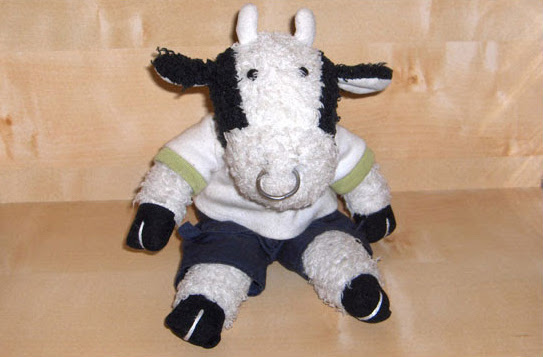
Fringe viewers to enjoy, too, although the urgency of Thursday night's "Jacksonville" suggests that when the show returns in April we're in for an emphasis on the alternate-universe antagonists. One of the great pleasures of The X-Files and, more recently, Supernatural is that even as their procedural premises gave way to greater focus on the series' mythologies, there were plenty of stand-alone standout episodes to be had, and Fringe has operated along similar lines. There's also been plenty of humor, most of it stemming from Walter's uninhibited glee over milkshakes, morbid experiments, and mind-altering substances, but also born of the absurdity the characters have come to expect as part of the job. Perhaps my single favorite shot of the series is of Astrid, Walter, Peter, and Gene the Cow eating Chinese take-out in the lab while watching Spongebob Squarepants.

"Once you are given the order to put on the headphones, do not remove them under any circumstances. If you do, you may die a gruesome and horrible death. Thank you for your attention and have a nice day!" — Walter Bishop

Those of you unfamiliar with
Fringe could do much worse after the logjam of February's sweeps programming subsides than to watch Season One on DVD, then catch up with as much of Season Two as Hulu, your friends' DVRs, or your ITunes budget will allow before new episodes resume in April. The ethical, existential dilemmas raised by the Pattern plotlines are intriguing, but the show is hardly for science-fiction fans only. The acting is solid, the dialogue is crisp, the relationships are genuine, the stakes are high, and the action is intense. Like I said, Fringe is good, and it might even be great.

01 February 2010

Lost in Thought: Tomorrow Never Knows


Yes, I think I'm gonna continue the trend of Beatles songs as titles if these Lost posts become a regular thing. An insane number of them feel tantalizingly applicable. The hard part will be deciding what to use and what to hold in reserve in case of an even more spot-on association down the line.

Season 6 will hit just about 24 hours from now, and I have lots of nuggets accumulated that should have been shared long ago, so let's take a little — no, wait, I decided not to use that one yet. I'll be adding to this olio over the next day, so check back for updates or sign up for the blog's RSS feed.

Here's one of the many snazzy E-cards that ABC released late last year. You can theoretically have them sent to yourself or a friend, but mine never arrived.

Image © 2010 ABC Studios.

I had the rare opportunity to sit down with my laptop in a coffee shop today. No sooner did I begin to jot down some thoughts on you-know-what than one barista, a fella, broached that very subject with another barista, a gal. And I couldn't not overhear their conversation.

What became pretty clear pretty quickly is that Fella was indeed a fairly die-hard fan, but while admitting his deep love he was hesitant to contradict Gal. As you will see, Gal was not as well-informed on the topic and, it seemed, played up her interest in the show in the name of flirting.

I didn't get everything, as evidenced by the ellipses, because I was typing furiously as they were talking and this wasn't a conversation that I could rewind. The coffee shop was also rather small and I began to get self-conscious about my transcription becoming obvious.

Fella: I was wondering if you could take my shift tomorrow night.
Gal: Do you have plans?
Fella: You know that show Lost? I really love it.
Gal: I love that show! I didn't know they were going to make another season. [!!!]
Fella: Oh, yeah.
Gal: What is it, Season 7?
Fella: Yeah, I think so.
Gal: Didn't it end with a nuclear explosion? ...
Fella: I was thinking of bringing a TV in here and inviting my friends to come here. I could even have Lost Tuesdays, but I just want to geek out with it. I need to pay attention.
Gal: Like the last season, I was like, What?
Fella: I don't even know where they're going to go with it. How are they going to wrap it all up?
Gal: The one moment in Lost where I was really, like, I hate the writers, was when they shot that blond chick, Shannon. I guess they got sick of writing for her.
Fella: Yeah, Sayid still had that other girl in his flashbacks but he, like, hooked up with Shannon.
Gal: Then they killed that other chick.
Fella: She got hit by a car. ...
Gal: Jack and Sawyer are just, like, pretty boys.
Fella: They're like Luke and Han. You can't make it up, just steal from the best.
Gal: You can't not rip off Star Wars, though.
Fella: Oh, totally. I think it's funny that they even made Sawyer look like Han Solo. They even gave him, like, Hurley as a Chewbacca, and they're like best friends.

I missed the very end without realizing that it was the end.


Bob D'Amico photo of Michael Emerson as Ben Linus © 2010 ABC Studios.

Whatever you think of Ben — he's good, he's bad, he's amoral, he's misguided, he's misunderstood — there's no denying that Michael Emerson and Lost's writers have made him perhaps the most compulsively quotable character on television.

I've joked over at Nik at Nite that I would snap up a book titled "I'm a Pisces": The Wit & Wisdom of Benjamin Linus in a heartbeat. Matter of fact, I should be pitching it right now. But unlike so many of the other great lines on the show, even those that are inextricably tied to the personalities of the characters speaking them (dude, I'm looking at you, Hurley), Ben's remarks are more often than not as much about context as content and delivery.

For every stand-alone classic like "Destiny, John, is a fickle bitch," there's the above title to my would-be bestseller. The preceding line of dialogue is from the Man in Locke: "Can I ask you a question?" Ben's reply isn't just witheringly dry, it's quintessentially him because it's a lie. Same thing with his half of an exchange aboard the back-to-the-Island express known as Ajira Flight 316: Ben appears to be buried in James Joyce's Ulysses and Jack asks "How can you read?" Says Mr. Linus, "My mother taught me." We know from a flashback that Ben's mother died in childbirth, and based on the mention of his birthday in the same episode we know he's not a Pisces, either; he's just a compulsive liar, or at least a control freak so dependent upon manipulation of those around him that speaking the truth is a tactic reserved for special occasions.

Some viewers have been confused and even touched by a comment that Ben makes as he looks at John Locke's suspended, lifeless body in "The Life and Death of Jeremy Bentham". Ben has found Locke on the verge of hanging himself, talked him down, extracted crucial intelligence, strangled Locke himself, arranged the body to resemble a suicide, and wiped his prints from the room; standing in the doorway, Ben says in his familiar quiver, "I'm going to miss you, John."

Maybe he's covering his ass because he believes that the Island can hear him somehow, maybe he truly respected John as an adversary, and maybe he even saw Locke as a kindred spirit. What amazes me about the delivery is that you just can't tell, but it's not because Emerson doesn't have range; it's because Emerson can convey so much enigmatic nuance within the limited range that Ben has learned to confine himself to — apparently even when he's alone — if he's going to be effective at what he does.

Ben has two basic inflections, to my ears. The one used when he says, "I'm going to miss you, John," rises slightly at the end of a sentence, like an unresolved chord. It reminds me both of the line "He'll rip your lungs out, Jim," in Warren Zevon's "Werewolves of London" and of Super Chicken's immortal phrase, "You knew the job was dangerous when you took it, Fred." If you're unfamiliar with Super Chicken — which ran as a segment on the classic cartoon series George of the Jungle, produced by Jay Ward and Bill Scott of Rocky and Bullwinkle fame — you can hear the line as a WAV file via the sounds archive at Dave's Un-Official Super Chicken Homepage (whose front I haven't linked to directly due to the ambush clucking); that line reading doesn't quite have the usual ending, but thankfully another WAV file of a similar line does.

The other inflection, used for "I'm a Pisces" and "My mother taught me," is more deadpan. Emerson manages to employ it in such a way that it can convey disinterest, resolve, or disdain with the merest tweak. When the apparently resurrected Locke (now known to be the Man in Black in Locke's body) confronts Ben over his homicide, Ben's five-star retort is "Well, I just didn't have time to talk you back into killing yourself." This may be a rare instance of Ben telling the truth, which makes it all the more blackly humorous; it's consummate Ben to say something so morbid with such exasperation, and we suspect that he could have talked Locke into getting the noose back around his neck given a slightly longer deadline.

Even that, however, is not the funniest piece of dialogue relating to what transpired in Locke's apartment. No, I direct you instead to a comment from Ben to Sayid: "John Locke is dead. I think he was murdered."


Photos © 2010 ABC Studios. Logo TM and cover arrangement © 2010 Entertainment Weekly.

Entertainment Weekly's coverage of Lost is almost always good stuff, but the cover of the latest issue feels surprisingly sexist. The captions read like so:

Jack Did his scheme work?
Locke Is he really dead?
Kate Does she pick Jack or Sawyer?
Sawyer Who survived the bomb?
Boone Why the heck is he back?
Sun Will she find her husband?

Aside from the fact that the Boone photo and caption are hilariously random (unless, out of all the past characters touted as making at least brief returns to the show, he ends up being particularly crucial to the plot), this is just not well thought-out. Sawyer's caption is vastly less specific to him than the others are to their subjects. One could ask, Can he reunite with Juliet? or Does he end up with Kate?

Sun's caption is legitimate, and I'm not saying that relationships haven't been important to the show; in fact, they're at its heart, but family bonds have meant as much as or more than any love polygon. I'd rather ask of Kate, Will she bring Claire back to Aaron?

EW has plenty of female staffers and has of course championed plenty of female authors, actors, and recording artists for their talent without any regard to gender. I have no problem with the mag devoting style pages to ladies' red-carpet fashion or referring to "chick lit" either — especially since the writers/editors doing so are usually ladies themselves. These captions just struck me as weird, especially for a show that not only has tough women but men who are as wrapped up in bad romance as anyone.

27 January 2010

Lost in Thought: Here, There, and Everywhere


Lost logo TM ABC Studios; Soft Watch at the Moment of First Explosion © 1954 Gala Salvador DalĆ­ Foundation.

It's about time.

ABC re-aired the finale to Season 5 of Lost last night. The final season begins next Tuesday with a two-hour episode starting at 9 p.m. ET, following the traditional series-recap clip show. You probably either know this already or just don't care; while casual viewers of the program are rumored to still exist, at this point it's hard to imagine they outnumber the Oceanic 6.

Lost was one of the first things I wrote about on this blog. I'd thought it would become one of the things I wrote about most, aside from comics, but a few things happened to belie that expectation — chiefly lapses in 'Net accessibility, problems with Blogger, and so much great discussion over on Nik at Nite that the week between episodes flew by before I could cobble together a stand-alone post of my own insights. Maybe I'll be able to cover Lost regularly this season, maybe not, but I would like to throw out some ideas on the show's past, present, and future before the end begins, starting with a theory I formulated shortly after last season's finale first aired. If you're unfamiliar with the show, from here on in you'll unfortunately be... well, you know.

The white flash that we saw at the end of Season 5 pushed my — and millions of others' — mental mandibles into overdrive. Lost already had us chewing over the twisted time-travel taffy of whether the castaways who ventured into the past had always been there, if the lives they had lived in the (more-or-less) present of the show before the time "bloops" occurred were immutable, and how everyone would get back to the future.

Was that flash simply the result of Juliet's successful detonation of the hydrogen bomb in 1977?

Could the fact that the white flash resembled the previous effects signaling the turning of the Frozen Donkey Wheel, the time-skipping of those left behind, and, earlier, Desmond's fail-safe destruction of the electromagnetic lode in 2004 — despite the characters' description of the latter as resulting in a purple sky — mean that the bomb served as the catalyst that Jack hoped it might, based on Daniel's theories, destroying the lode and thus resulting in a timeline wherein there was no EM pulse to bring down Oceanic Flight 815 in the first place? (Whew.)

Was that flash instead either the Island or Jacob recalling our protagonists to his side at the moment of his apparent death, just as other passengers on Ajira Flight 316 saw Jack, Kate, Hurley, and Sayid disappear in blinding light before it crashed in 2007, sending the four thirty years back in time to reunite with Sawyer, Juliet, Miles, Jin, and Daniel?

I don't know if the answer to any of the above is yes. The characters themselves may not even have seen the white flash at all; perhaps it was merely the producers' way of telling viewers used to having episodes end with a pitch-black screen that things have fundamentally changed: Lost's ongoing juxtaposition of black and white, which dates back to Season 1 (and is but one of its many dichotomies) was, after all, reflected again when the Season 5 finale showed us both the oft-mentioned Jacob, fair-skinned and dressed in white, and his apparent opposite number — unnamed in the story but dark-haired and popularly referred to as the Man in Black, whom I took to calling Esau even though he and Jacob aren't likely meant to represent the Biblical brothers exactly. Until now the balance of power might have been in Esau's favor and, despite appearances, it could have just shifted to Jacob's. Of course, setting our cultural bias aside, we also don't know which color and therefore which man represents good and which evil, if those are even valid concepts to apply. The one thing of which I am fairly certain is that we've been set up for yet another expansion of a playing field that's grown season by season and that's about to get seriously vast.

What follows is not meant as a series recap, but it may help remind you of some of the show's more significant developments as I build a case for the tableau upon which Season 6 might well unfold.

Season 1 began with the crash of 815 on the Island in 2004 — in fact, on the very date the pilot episode aired. Jack's eye, in close-up, was the first thing we saw. The castaways lived on the beach and some explored their new home, which most hoped was temporary. The caves were discovered, Sayid met Rousseau during his self-exile, and Locke went hunting, finding both the airplane that we'd later learn was connected to Mr. Eko and a buried steel hatch that would soon give its name to the bunker below. We were also introduced to the Whispers, to the sounds of the Smoke Monster, and to the Numbers. Claire brought new life to the Island amidst much death when she delivered a baby boy.

At the end of the Season 1 finale, we finally got a glimpse of the Monster's wispy tendrils around Locke's ankles and made two surprising leaps of geography: off the Island, if not far, and under it. Michael's raft actually set sail with Walt, Jin, and Sawyer aboard, only to bring us face-to-face with the Others for the first time as they took "the boy"; meanwhile, Jack, Kate, and Locke peered down into darkness after successfully opening the Hatch (on which were printed those "cursed" Numbers, much to Hurley's dismay) — a major expansion of setting for Season 2.

Season 2's opener seemed to start with a flashback, but it was actually our introduction to the long-suffering Desmond, stuck in a time capsule. The so-called Hatch, a.k.a. the Dharma Initiative's Swan station, became central to the action; it let the castaways do laundry, stock food from the mysterious pallet drops, and, oh yeah, push a button every 108 minutes to purportedly save the world. As the very revelation of the DI and those fascinating videos offered a whole new dimension to the show's mythology, the cast of characters also grew to include not just Desmond but another group of Oceanic 815 survivors — the Tailies, including Eko, Ana Lucia, Libby, and Rose's husband Bernard — and the man ultimately revealed as Ben, leader of the Others. Season 2 ended with more new locations in the form of the Others' camp and, astoundingly, our first contemporary (i.e., non-flashback) glimpse beyond the Island as Penny was notified of the blip caused by the spike in electromagnetic energy that occurred when Desmond turned his fail-safe key.

Season 3 spent considerable time, to many viewers' and even producers' chagrin, with the Others and their captive castaways on the Next Island Over, home of the Hydra station. Perhaps its biggest expansion was in Desmond's consciousness, as the detonation of the EM lode seemed to give him limited clairvoyance after he experienced, rather literally, the flashback of his life. We also got the much-maligned introduction of Nikki and Paulo, shoehorned-in background characters who, like the Tailies, were supposed to add another perspective to day-to-day existence on the Island; the less charitable explanation is that, as with the time Jack, Kate, and Sawyer spent in New Otherton, the showrunners were treading water with the grand arc of the series since there was no indication of how much longer it would have to sustain itself on the air.

Once the Lost brain trust and network executives had worked out a plan to wrap the series up after three more seasons, the Season 3 finale delivered yet another game-changing reframing of the playing field: Just as we were taken down the Hatch in the closing moments of Season 1 and off the Island to Penny's monitoring station at the end of Season 2, what we thought was an increasingly puzzling flashback was revealed in Season 3's last lines of dialogue to be a flashforward.

Flashforwards became common in Season 4, which began the show's not-quite-symmetrical mirroring of itself. Juliet, Ben, and Richard of the enigmatic Others (each inducted into that society in a very different way, with Richard's origins still untold) were made major players in Season 3, and Season 4 brought new antagonists to the Island in the form of the Freighter Folk. It also revealed the Oceanic 6's off-Island lives after their return to the outside world — selectively, of course, much as their pasts had been revealed via meaningful if sometimes cryptic flashbacks — and its finale brought us right to where we'd been a year earlier, with Kate meeting a distraught, bearded Jack at the airport in 2007. While that episode aired in 2008, only about three months of on-Island action had transpired during the series' previous three seasons, so the baseline "present day" of the series was still 2004, making the flashforwards windows into the narrative if not the actual "future".

Viewers by now expected not just surprises but mind-bending twists from season finales, and Season 4's didn't let them down. Dharma stations had played significant roles in each since the Swan's destruction in the Season 2 finale — if not since the opening of its hatch door at the end of Season 1; the heartbreaking Season 3 capper had Charlie sacrificing his life to contact the outside world in the underwater Looking Glass station, and come the last hour of Season 4 Ben traveled far below the Orchid to turn the Frozen Donkey Wheel. Jack, Sun, Hurley, Sayid, Desmond, Frank, and Kate, with Claire's infant son Aaron, watched from a life-raft, having already been flown by Frank to the freighter that was "not Penny's boat" only to see it destroyed with Michael and apparently Jin still aboard, as the Island vanished in a flood of bright light. Luckily for them, Penny's boat showed up in short order, but Ben's actions, we learned in Season 5, set the castaways who were left behind — now including the misfit special-ops team of Miles, Daniel, and Charlotte — adrift in time.

Season 5's opener seemed to start with a flashback, and it did turn out to be set roughly three decades in the past, complete with the eerie sight of the Dharma Initiative at work filming an orientation video and constructing the Orchid, but the appearance of Daniel threw everything into question. Flashbacks and flashforwards took on new meaning as the "present-day" storyline bifurcated: One track followed the slow re-assemblage of the Oceanic 6 and their return to the Island, culminating in the crash of Ajira 316 at the Hydra facility in 2007; another followed those left behind as they jumped wildly through time until Locke set the Frozen Donkey Wheel right and settled Sawyer, Juliet, Miles, Daniel, and, separately, Jin, Rose, and Bernard in 1974 during the early days of the DI's Island occupation. The groups were partially reunited when a quartet from 316 were transported to 1977 as the Left Behind group's narrative in Dharmaville jumped ahead three years to intersect with theirs (somewhat controversially, it must be said; viewers had been clamoring to see the gang back together, but it was hard to process the bonds that had been formed among Sawyer's posse from 1974 to 1977 given that the three years elapsed in a blink for us, while as noted the previous three-plus years of the series had covered only that many months). Sun, Ben, Frank, and Locke's body remained in 2007, along with a new group led by the largely unknown Ilana. Richard, of course, was "everywhen" — although not, apparently, as some had theorized earlier, all at the same time. In another symmetrical bond, Season 5 climaxed with Juliet attempting to release the Island's electromagnetic energy by setting off that hydrogen-bomb core at the Swan's construction site in 1977, mirroring Desmond's actions at the Swan in 2004 in the finale of Season 2.

Each new season has brought substantial expansion of Lost's mythology, with bolder introduction of critical characters than is usually seen in series television. And it might have been enough that the cast expanded to include the Tailies in Season 2, the Others in Season 3, the Freighter Folk in Season 4, and the actual Dharma Initiative in Season 5. What I've tried to show neither too subtly nor with a sledgehammer, though, is how each new season annexed a new location and even a new dimension — with the final, thrilling moments of each finale often hinting at the wider vista of the season to come.

Season 1's exploration of the Island was largely topographical, but it went subterranean in Season 2 with its focus on the Hatch. Season 3 took us offshore to the neighboring Hydra station and eventually underwater to the Looking Glass, not to mention through Desmond's consciousness. Season 4 brought a new group of outsiders to the Island, but more importantly shifted from flashbacks to flashforwards, showing us not only what had happened in our castaways' lives but what would happen. Season 5 went one better and, with the ground softened by not just those authorial conceits but brief looks at some characters' nonlinear perceptions, brought us out-and-out time travel, plus simultaneous (or what passed for it, all things considered) action both on and off the Island. Now that Lost has progressed from roaming the length and width of the Island to exploring its depths and its surroundings to, finally, piercing the temporal veil, there's only one place left to go — and when I say the fifth dimension, I'm not talking about musical competition for Mama Cass, Geronimo Jackson, or Three Dog Night; I'm talking about alternate timelines.

Plenty of mysteries still exist that may be explained within the confines of the narrative to date; for real uncharted territory, however, we have to go beyond the world we've seen to what might have been or, in the hopes if not the beliefs of some characters, what should have been and could yet be. The introduction of Jacob in the flesh or something like it in Season 5's opener and the finale's revelation that the Man in Black has been masquerading as Locke were stunners, but that white flash is what was placed in the finale's very last moment, the spot occupied in previous seasons by our long look down into the darkness through the hatch, Penny on the telephone with her monitoring station, the shock of Jack's "back to the island" exhortation, and the camera pan to Locke in the coffin, each of which directly propelled the central plot of the season to come. Yet the flash frustratingly gave us the least information out of any of those scenes; it was a split-second showpiece with no indication even of whether it was a cause or merely an effect.

The time-tossed castaways have accepted death as an option given just the possibility that the bomb's detonation will result in a future with no electromagnetic lode on the Island to be regulated by the pushing of the button, and thus no failure to do so on Desmond's part that would result in the crash of Oceanic 815. Jack wants to save the passengers who died during or after that crash and perhaps even moreso to never have met Kate; Juliet is determined to similarly never have met and thus never have lost Sawyer, who with the reappearance of Kate is in her eyes no longer the James with whom she had built a life.

Why their projection of how an event in 1977 might change history is so narrowly focused on a single day in 2004 requires intervention from either film buff Hurley, common-sense Miles, or theoretical physicist Daniel (who admittedly got this ball rolling in the first place); Lost being Lost, with its strong theme of destiny and interconnectedness, it's entirely possible that Season 6 will indeed open with those same passengers on that same plane thirty years hence, regardless of what has transpired on the Island or in their own private lives in that time, but I'd like to see a third path rather than one of the two usually debated as the likely possibilities since that finale. Whether the castaways have caused the very Incident that led to 815's crash, and thus are playing out some ironic endless loop, or have pre-empted it and somehow changed the course of their lives merely from the moment of 815's flyby of the Island onward — instituting one heck of a paradox in doing so, by the way, since if they don't crash they won't end up in the position of detonating the bomb — is less interesting to me by far than the possibility that the detonation has ripped open the fabric of the multiverse so that various realities become visible to us and perhaps even intersect. Some fans have theorized that we've already seen alternate timelines in play, their evidence including but not necessarily limited to differences in dialogue and set dressing when flashbacks are revisited from different perspectives; frankly, we've seen continuity errors so egregious for a show that asks its viewers to pay such close attention to detail that the more nitpick-oriented might appreciate this being the case if only to explain such errors away.

Chances are good that much better ramblings on this topic than the above have popped up often and independently across the Interwebs, but I've been on hiatus from Lost lore for the past eight months outside of trying to keep up with Nikki Stafford's Rewatch. For all I know, spoilers have leaked that would shape, dispute, or even invalidate much of my observations, but part of the fun of this phenomenon is overthinking things, the only danger in doing so being that the paths chosen by the storytellers won't live up to one's own imagination.

Lost resumes next Tuesday, and it's about time. Actually, it's about time and space and maybe parallel dimensions too. Jacob told us that they're coming, and there might be more of them than we ever imagined.

25 January 2010

Screen Savor: Monday TV


All of a sudden, Mondays are as crowded as Thursdays — as far as
my viewing schedule goes, anyway. I used to check whether Castle and How I Met Your Mother were repeats, then either in-between or instead of them catch up with other shows on tape or online. With 24 and Chuck back on the schedule, plus the new, ballyhooed Life Unexpected, the night is more likely to feed the backlog than help clear it out.

Photo and logo © 2009 ABC Studios.

Castle, airing 10-11 p.m. on ABC, is basically the same show I reviewed back in August. Fine by me.

We did get a big "mythology" moment just last week, when a new case dovetailed with the unsolved murder of Det. Beckett's mother. It left little — but, yes, some
— room for further exploitation, a surprising development so early in a series that by design has no real backstory to address beyond what made its lead cop become a cop; I just hope this doesn't mean that any sweeps stunts or season-ending cliffhangers deemed necessary will revolve exclusively around artificially pushing together or pulling apart the Beckett/Castle duo, who are pretty much right where they should be until we're rewarded with their inevitable series-ending romance.

The show has also found Castle's personal sphere colliding more often with his now open-ended ride-along stint in Beckett's NYPD Homicide team — both intentionally (as when Castle's daughter interns at the precinct or goes to Beckett for girl talk) and otherwise (as when foul play strikes the high-society set, including the bridal party of Castle's college sweetheart). Mostly, though, the domestic scenes are grace notes to the flirtatious banter between Nathan Fillion as Castle and Stana Katic as Beckett, the irreverent morgue humor among the supporting cast on the street or at the station, and the sometimes grisly but usually gripping enough murder-mystery of the week.
Castle is very satisfying television.

Promotional poster © 2010 20th Century Fox Film Corp.


24 kicked off its new season last week with what's become the traditional four hours over two consecutive nights; it settles into its weekly Monday slot tonight at 9 p.m. on Fox.

I've toyed with ditching the show on occasion, and for a couple of seasons in there I wish I actually had, but both its trademark unevenness and its trademark immediacy (only the latter is intentional, of course) in a way make
24 work contrary to most serial fiction. A lot of purposefully complex or just plain long-running TV and comic-book series depend on knowledge of loads of previous characters and plot points; you may not have seen or read those stories, and if you did you may not have enjoyed them, but you'd better either remember their details or be prepared to do some research to re-enter the Star Trek, X-Men, or General Hospital universe. Where those franchises are all about churning out new stories, mining and often cannibalizing what has gone before as part of a never-ending saga, 24 by its definition each year has resolutions set up as goalposts from the start but invariably relies on subplots and misdirections that are often made up as the season takes shape; you don't actually have to know much of what goes on in the middle episodes, but except for laughers like the infamous Season 2 cougar sighting the urgency of those split-screen scenes and that ticking clock sure make them exciting at the time.

So with CTU disbanded and all but about three of its perennial characters having bit the dust, I would have been fine with last season being
24's last season. The show broke ground in both style and content, but I've probably seen the best of what it has to offer; surely, the longer it goes on the more unbelievable it is that Jack Bauer and even moreso our nation's psyche can endure any further figurative or literal bombshells without the narrative better reflecting their impact: Over the past nine years — which, granted, I think have corresponded to more than a dozen years in-story, based on references to time elapsed between seasons — a nuclear device has been detonated in the heartland; Air Force One has gone down, incapacitating the President; the Secretary of Defense has been kidnapped by terrorists; a former President, the first black man elected to the position, has been assassinated; the Cabinet has voted to temporarily remove another President from power; internment camps for Muslims were temporarily enacted; yet another President has been in cahoots with an extragovernmental cabal, then left office permanently only to be stabbed by his ex-wife when the worst he got was house arrest; the air-traffic control grid has been seized by terrorists, who caused planes to crash into one another over Washington in an attempt to deter the country's first female President from intervening in a situation overseas; and the White House has been rather ridiculously invaded by the leader of that coup with the President held at gunpoint on live television. Yeah. And that's just from mulling it over without doing the Google, not to mention without tacking on the real-world terrorist attacks of Sept. 11th, 2001, which occurred after the first season of 24 began production but fallout from which has been referenced on the show. We saw Bauer break down privately under the weight of what his job has cost him in an achingly powerful performance from Kiefer Sutherland at the end of Season 3, but the world at large is reset to more-or-less business as usual each year to a greater extent, it feels to me, than even humanity's tendencies towards compartmentalization and self-absorption would allow.

At least the reconstituted CTU in Season 8 has tech that's visually on par with
CSI, although it's good to see Jack Bauer sticking with his shoulder bag. While I can't imagine many folks are trying 24 for the first time this far in, I should explain that CTU stands for Counter-Terrorist Unit and is 24's fictional domestic branch of the CIA; Jack once worked out of the very active LA division and has gone undercover, gone apparently rogue, or gone on to greener pastures many times over, but ol' JB's middle initial must be O because he's now in NYC — with plans to join his daughter's family on a flight back to LA this very night — just as an old informant turns up with news of an imminent assassination attempt that will scuttle negotiations between the US and the leader of Fakenamistan over deposits of unobtainium in...

No, I shouldn't joke about even make-believe "peace in the Middle East". But from the way that phrase is thrown around, you'd think the talks were more directly about the conflict among and around Israel, the Palestinians, and neighboring Arab or Muslim states instead of a treaty with a stand-in for Iran to provide aid in exchange for a cessation of nuclear ambitions. And I'll continue the
24 talk later because I don't want the now-flickering Internet connection to drop out before I can post a recommendation for the night's new critical darling.

Promotional poster © 2010 The CW Network LLC.


Life Unexpected, airing 9-10 p.m. on The CW opposite 24, premiered last week after months of hype from the network and excited TV-beat writers.

My current CW diet consists exclusively of the delicious
Supernatural. Its predecessors, UPN and The WB, had larger cultural ramifications but for me likewise mattered mostly due to what the trade mags dismissively refer to as "genre" offerings — namely Angel and Buffy the Vampire Slayer, even if the latter especially was so much more than a fantasy series; I didn't follow any of the teen-centered family or surrogate-family series beyond Buffy and Gilmore Girls (both of which I fell for belatedly but hard) unless you count the first-rate, last-place Veronica Mars in that category as well.

While it's unlikely to live up to the direct comparisons to
Gilmore on which it's being sold, Life is lucky to have at its center Britt Robertson — the strongest of the kids on CBS's Swingtown, who were in turn the most compelling part of that show. The pilot, available to play at the CW website at least until tonight's episode goes up, introduces Robertson as Lux, whose pinball existence in the foster-care system explain her sass and independence if not her quirky-chic wardrobe (I've known some truly devoted foster parents, but it's made clear that Lux has been stuck with families who just want her for the check). She aims to track down her biological parents for their signatures so that she can become emancipated on her 16th birthday, only it turns out that Mom and Dad — who haven't seen each other since high school — were no older than Lux is now when she was born, and in fact they still haven't "grown up": One lives above the bar he owns, the other is a radio talk jockey who's been speaking to her daughter over the air every morning without knowing it and who just got engaged to her co-host in a potentially misplaced bid at moving on in life.

You're welcome to ponder the show's tightrope act in offering the very lifestyles that make Cate and Baze, Lux's folks, cool and relatable (to their kid and, presumably, most of the target demographic) as evidence of their arrested development and lack of fitness for child-rearing, but one hopes that surprising emotional maturity will be coaxed out of all corners of the motley crew that assembles for Lux's birthday party at the premiere's conclusion. I hear that tonight's episode moves on nicely from the established premise and look forward to giving
Unexpected a chance. How about you?